

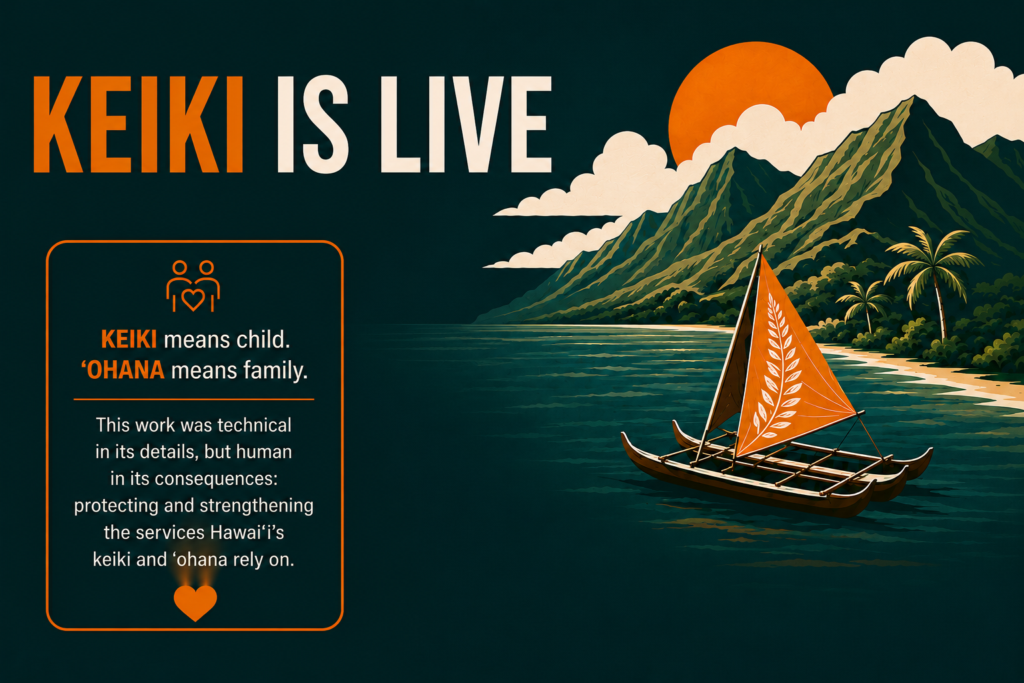
KEIKI is live.
On July 20, Hawaiʻi’s Child Support Enforcement Agency moved KEIKI off its legacy mainframe and onto a modern, secure, and scalable technology foundation. The transition happened on schedule and without interruption to child support services. Here are three key ideas that shaped our approach.
1. Technology should adapt to the mission, not the other way around.
A legacy system is more than old technology; it carries institutional memory. That’s what makes replatforming hard: remove too much, and you lose knowledge the agency depends on; preserve too much, and you carry old constraints into the new system. That’s where Protech’s experience matters most. The real work is knowing what belongs to the mission—and what belongs to the machinery. It means rolling up our sleeves, uncovering the logic worth preserving, and letting the mission, not a preselected product, shape the solution.
2. Stewardship of public dollars is part of the mission.
We’ve never been interested in looking big or flashy. We’d rather put experienced people close to the work, make decisions quickly, keep layers thin, and deliver. That philosophy shapes our delivery model: fewer handoffs, less overhead, and clear accountability for the outcome. It’s why Protech and the State chose to deliver KEIKI entirely remotely with a distributed team, reducing travel costs and avoiding expenses that added no value. Public dollars should pay for judgment, expertise, and results—not layers, overhead, or unnecessary complexity. Respecting the mission means respecting the money behind it, because ultimately, those dollars belong to the people and are meant to serve families. We treat every public dollar with the same care we would our own.
3. The real value of replatforming is the next change it makes possible.
Our role was never to make Protech indispensable. It was to make CSEA’s technology more capable—and its team better able to understand, test, operate, and improve the system after the implementation team stepped away. That is how we measure replatforming: not only by whether the system works on launch day, but by whether the next change becomes easier to make. Protech helped leave the State with reusable testing infrastructure, stronger documentation, repeatable processes, and cross-trained teams. These may not be the most visible parts of a project, but they are often among the most lasting. They make future change safer, faster, less costly, and less dependent on any one vendor.
KEIKI means child in Hawaiian, and ʻohana means family. We return to those words as we return the work to its real purpose because this project was technical in its details, but human in its consequences: protecting and strengthening the services Hawaiʻi’s keiki and ʻohana rely on.
We are so very proud to have served as CSEA’s implementation partner, and grateful to the agency leaders, program experts, technologists, testers, operators, federal stakeholders, and project partners whose care and persistence made this transition possible.
Leave a Reply